Sustainability rests on three interconnected pillars that determine whether our actions today will support or undermine tomorrow’s prosperity. The environmental component addresses how we manage natural resources and ecosystems. The social component examines equity, health, and community well-being. The economic component focuses on creating financial systems that distribute value fairly while respecting planetary boundaries.
Understanding these three components turns sustainability from an abstract idea into a practical framework for decision-making. When businesses evaluate new projects, communities plan development initiatives, or individuals make daily choices, the pillars give clear criteria for judging long-term viability. A sustainable approach needs all three working together. Environmental protection without social equity creates exclusion. Economic growth without environmental stewardship depletes resources. Social programs without economic viability can’t endure.
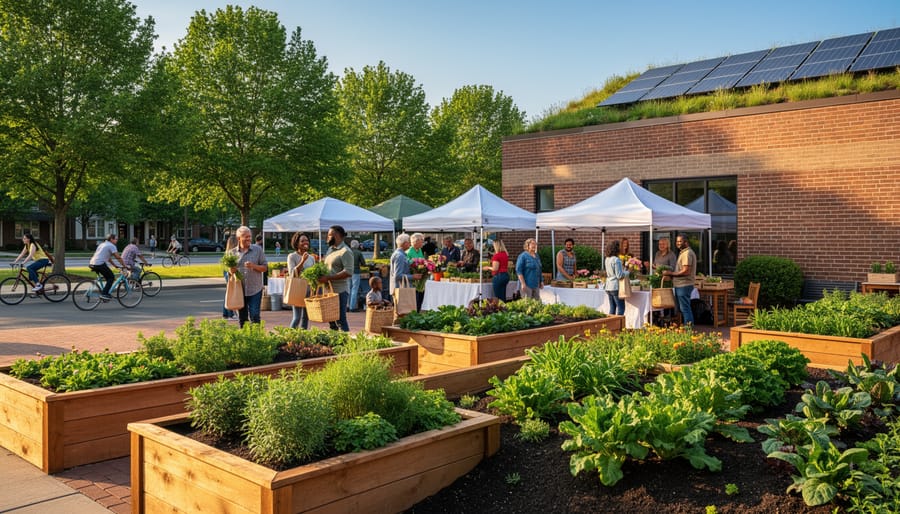
The real value of this framework is that it exposes hidden trade-offs and unexpected opportunities. A manufacturing facility might cut costs through energy efficiency while lowering emissions and improving worker health. A community garden can strengthen social bonds, reduce food transportation impacts, and create local economic opportunities. These overlaps show that sustainability isn’t about sacrifice. It’s about smart design that multiplies benefits across all three domains.
Organizations that integrate these components tend to outperform those chasing a single issue. They build resilience against disruption, attract engaged stakeholders, and create lasting change. Community-led work is where this plays out most visibly, and you can see how community action turns sustainability goals into real environmental wins when local people drive the process. If you lead an organization, shape policy, or simply make personal choices, knowing how environmental integrity, social equity, and economic viability connect puts you in a stronger position to contribute. The following sections look at each component in depth and offer practical steps you can apply right away.
The Environmental Component: Protecting Our Natural Foundation
Why Environmental Health Drives Everything Else
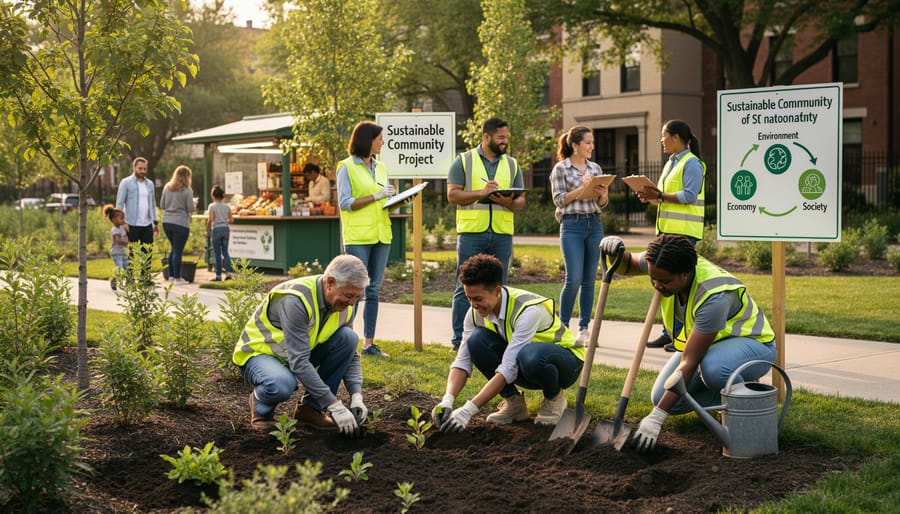
Environmental health forms the bedrock upon which all other sustainability efforts rest. Without clean air, water, and healthy ecosystems, communities cannot thrive economically or socially. This isn’t theoretical—we see the direct impacts when environmental systems break down.
Consider Flint, Michigan, where lead-contaminated water created a public health crisis that devastated community well-being, drained municipal resources, and eroded public trust. The environmental failure triggered cascading social and economic consequences that continue today. Similarly, communities near industrial zones often face disproportionate rates of respiratory illness due to poor air quality, limiting children’s ability to learn and adults’ capacity to work productively.
Biodiversity loss presents another critical concern. When ecosystems degrade, they lose their ability to provide essential services like pollination, water filtration, and climate regulation. The collapse of bee populations in agricultural regions has forced farmers to spend millions on manual pollination, demonstrating how environmental decline directly impacts economic stability.
Deforestation in the Amazon Basin offers a global example. As trees disappear, local communities lose access to traditional food sources and clean water, while the broader climate implications affect weather patterns worldwide. Indigenous populations, who have sustainably managed these lands for generations, face displacement and cultural erosion.
These examples underscore a fundamental truth: environmental health isn’t separate from human prosperity—it enables it. Protecting our natural systems means safeguarding the foundation that supports healthy communities, robust economies, and social equity. When we prioritize environmental integrity, we create conditions where all other aspects of sustainability can flourish.
How Communities Measure and Monitor Environmental Impact
Measuring environmental impact doesn’t require expensive equipment or advanced degrees. Communities worldwide are tracking their environmental health with accessible methods that produce useful data. Water quality testing is one of the most basic practices. With simple test kits from a hardware store, volunteers can check pH, dissolved oxygen, and pollutant concentrations in local waterways. Repeated readings build a baseline that shows trends over time and flags emerging contamination early.
Carbon footprint assessment has become far more approachable too. Free online calculators and mobile apps help households and organizations estimate greenhouse gas emissions from transportation, energy use, and consumption. Start with a baseline, set a reduction target, then reassess every six or twelve months to see whether the numbers are actually moving.
Biodiversity monitoring is another practical option. Residents can log local plant and animal species through smartphone apps, feeding regional databases that scientists use to gauge ecosystem health. Even plain observations, like a drop in the number of nesting birds or a decline in native wildflowers, work as early environmental indicators.
Air quality monitoring has also moved beyond government stations. Low-cost sensors let neighborhoods track particulate matter in real time, pinpoint hotspots, and test their suspicions about industrial emissions or heavy traffic. Researchers have documented how open-source citizen monitoring can give communities reliable, shareable data without a large budget.
What makes any of this work is consistency and local participation. When residents understand the methods and collect the data themselves, they feel a stake in the results and push harder for solutions. Numbers gathered by neighbors are difficult to dismiss. They turn vague worry into specific, actionable information, and that’s where real change starts.
Taking Action: Environmental Initiatives That Work
Community-led environmental initiatives demonstrate how targeted action creates lasting change. Zero-waste programs in San Francisco have diverted 80% of waste from landfills through comprehensive composting and recycling systems, proving that municipal-level commitment yields measurable results. Similarly, habitat restoration projects along degraded waterways have successfully reintroduced native species while improving water quality by up to 40% within five years.
Renewable energy adoption shows exponential growth when communities organize collectively. Solar cooperatives enable households to share installation costs and energy benefits, making clean energy accessible to middle-income families. In rural areas, community wind projects generate both electricity and local revenue, demonstrating the economic viability of sustainable infrastructure.
These successes share common elements: strong community engagement, clear measurable goals, and sustained commitment. Whether reducing carbon footprints through energy efficiency programs or protecting biodiversity through citizen science monitoring, effective environmental action combines scientific evidence with grassroots mobilization, transforming individual concern into collective impact.
The Social Component: Building Engaged and Equitable Communities
Creating Genuine Community Participation
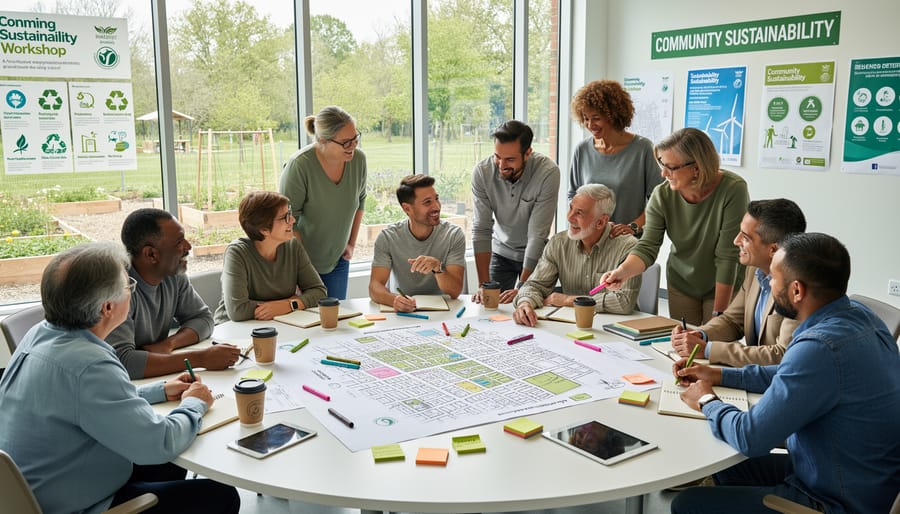
Authentic community participation transforms sustainability from a top-down mandate into a shared vision that reflects the needs and wisdom of those most affected by environmental decisions. Yet barriers like limited access to information, time constraints, and power imbalances often exclude marginalized voices from the conversation.
Breaking down these obstacles requires intentional strategies. Start by meeting communities where they are—hosting sessions at accessible times and locations, providing translation services, and using plain language rather than technical jargon. Digital platforms can expand reach, but shouldn’t replace face-to-face engagement that builds trust and understanding.
Meaningful participation goes beyond token consultation. Establish clear pathways for how community input shapes actual decisions. Create advisory committees with diverse representation, including youth, Indigenous communities, low-income households, and other historically underrepresented groups. Compensate participants for their time and expertise, acknowledging that unpaid volunteer models often exclude those who cannot afford to participate.
Transparency builds credibility. Share information openly about sustainability goals, challenges, and trade-offs. When conflicts arise between economic, environmental, and social priorities, facilitate inclusive dialogue to explore solutions that balance competing needs.
Evidence shows that community-driven initiatives achieve greater long-term success. A study of watershed management programs found that projects with robust stakeholder engagement were three times more likely to meet conservation targets while improving local livelihoods. By investing in genuine participation, we create sustainability solutions that are not only more equitable but also more effective and enduring.
Environmental Justice: Ensuring Fair Access and Protection
Environmental sustainability can’t be achieved without asking who bears the burden of environmental harm. Environmental justice starts from a documented pattern: low-income communities and communities of color face disproportionate exposure to pollution, toxic waste, and climate-related disasters. These residents often live near industrial facilities, highways, and contaminated sites, yet they have the least resources to protect themselves or relocate. The federal government has acknowledged the problem for decades, and the U.S. Commission on Civil Rights laid out its position in an environmental justice statement that frames fair treatment and meaningful involvement as civil rights concerns.
The social component of sustainability, one of the 3 components of sustainability alongside the environmental and economic, forces us to look at these inequities head-on. When corporations pollute without accountability, marginalized communities pay the price through higher rates of asthma, cancer, and other health conditions. Children in these neighborhoods may not be able to play outside safely. Families deal with reduced property values and fewer economic opportunities.
Organizations like the Community Environmental Resource Institute (CERI) work to level this playing field by holding polluters accountable and amplifying community voices in environmental decision-making. That advocacy gives the people most affected by environmental degradation a seat at the table when policies are crafted and enforcement actions are taken.
Organizing works. Legal victories against polluters, stricter regulations, and the cleanup of contaminated sites show what grassroots environmental justice movements can accomplish. When equity is built into sustainability efforts, the solutions protect everyone, not just those with privilege and resources. True sustainability means clean air, clean water, and safe surroundings are basic rights, available to all people regardless of zip code or income level.
Education and Capacity Building for Long-Term Change
Lasting sustainability outcomes depend on communities equipped with knowledge and skills to drive their own environmental solutions. Environmental literacy forms the foundation—when individuals understand local ecosystems, resource cycles, and climate impacts, they make informed decisions that ripple through entire communities. Research shows that education-focused sustainability programs generate 60% higher long-term participation rates compared to awareness campaigns alone.
Practical capacity building takes multiple forms: workshops on renewable energy installation, training sessions for community environmental audits, and mentorship programs pairing experienced advocates with emerging leaders. These initiatives create self-sufficiency, reducing reliance on external experts while building confidence within communities. Local expertise matters because residents understand context-specific challenges that outsiders might overlook.
Knowledge sharing platforms—from community forums to digital networks—democratize access to sustainability solutions. Document and share successful local projects so neighboring communities can adapt proven strategies. Empowering community leaders through leadership development programs ensures sustained momentum even as individual participants change. When education becomes embedded in community culture rather than one-time events, sustainability transforms from a temporary initiative into a permanent value system that guides collective action for generations.
The Economic Component: Making Sustainability Financially Viable
The Real Economics of Sustainable Practices
Contrary to persistent myths, sustainable practices deliver measurable financial returns that strengthen rather than strain budgets. Research from the International Energy Agency shows that energy-efficient building retrofits generate average returns of 20-30% over their lifecycle, with payback periods as short as three to five years. When organizations invest in LED lighting, improved insulation, and smart heating systems, they typically reduce energy costs by 25-40% annually while simultaneously lowering their carbon footprint.
Waste reduction initiatives prove equally profitable. Companies implementing comprehensive recycling and waste minimization programs report average cost savings of $15,000 to $50,000 annually, depending on scale. A landmark study by the Ellen MacArthur Foundation found that circular economy approaches—which prioritize resource reuse and waste elimination—could generate $4.5 trillion in economic benefits globally by 2030.
The lifecycle cost comparison tells a compelling story. While sustainable technologies may require higher upfront investment, total cost of ownership analysis consistently favors green alternatives. Solar panel installations, for instance, now achieve grid parity in most markets, with 25-year returns exceeding 300% in optimal conditions. Water conservation systems in commercial buildings recover initial costs within two to four years through reduced utility bills.
These numbers demonstrate that sustainability isn’t a financial burden—it’s a strategic investment. Organizations embracing evidence-based sustainable practices position themselves for long-term profitability while contributing to environmental protection, proving that economic viability and ecological responsibility are complementary, not competing, goals.
Green Jobs and Local Economic Development
Sustainability initiatives are powerful engines for local economic growth, generating diverse employment opportunities while addressing environmental challenges. The renewable energy sector alone has created millions of jobs worldwide in solar panel installation, wind turbine maintenance, and energy efficiency consulting. These positions often provide competitive wages and require varied skill levels, making them accessible to different segments of the workforce.
Environmental restoration projects employ local residents in reforestation, wetland rehabilitation, and ecosystem monitoring, directly connecting communities to their natural surroundings while providing meaningful work. Green technology companies drive innovation in sustainable product design, waste reduction systems, and clean transportation solutions, establishing new industries in regions willing to invest in environmental futures.
Sustainable agriculture creates employment in organic farming, urban gardening initiatives, and local food distribution networks, strengthening food security while keeping economic benefits within communities. Research shows that green investments typically generate more jobs per dollar spent compared to traditional industries, demonstrating that environmental responsibility and economic prosperity can advance together.
Communities embracing sustainability initiatives experience multiple economic benefits including reduced energy costs, improved public health outcomes that lower healthcare expenses, and enhanced property values. These investments build resilient local economies less vulnerable to environmental disruptions while positioning communities as leaders in the growing global green economy.
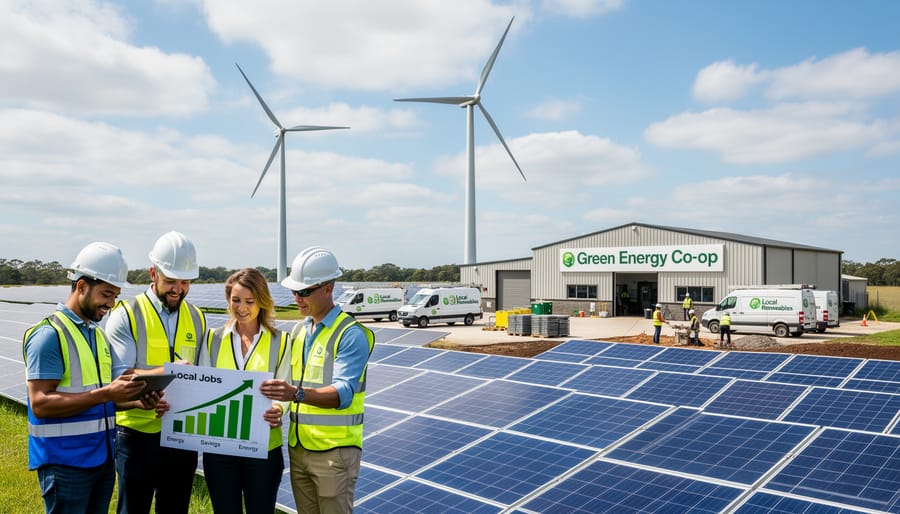
- Economic
- Local employment, lower energy bills, and higher property values keep money and opportunity within the community.
- Environmental
- Restoration work, clean energy, and waste reduction protect the ecosystems that communities depend on.
- Social
- Accessible jobs, better public health, and stronger food security improve daily life and reduce healthcare costs.
- Green job
- Any role that directly supports environmental protection or resource efficiency, from solar installation to wetland monitoring.
Funding and Financial Models for Community Sustainability
Securing financial resources remains essential for implementing community sustainability initiatives. Federal and state grants through agencies like the Environmental Protection Agency and Department of Energy provide crucial seed funding for renewable energy projects, green infrastructure, and environmental restoration efforts. Community development financial institutions offer specialized lending that prioritizes social and environmental returns alongside financial sustainability.
Public-private partnerships create powerful mechanisms for scaling local projects by combining government resources with private sector innovation and efficiency. These collaborations can fund everything from community solar gardens to urban agriculture initiatives. Green bonds and impact investing have emerged as innovative tools, allowing communities to attract capital specifically designated for environmental projects while generating measurable social benefits.
Crowdfunding platforms and community investment cooperatives democratize funding access, enabling residents to directly support local sustainability efforts. Some municipalities have successfully implemented carbon fee systems where revenues fund energy efficiency programs and climate adaptation measures. The key lies in diversifying funding streams and demonstrating clear environmental and social returns to attract sustained investment in community-led sustainability projects.
What are the 3 components of sustainability, and how does funding relate to them?
The three components are environmental, social, and economic. Funding ties them together because a project needs financial backing to deliver environmental benefits and community value over the long term.
Where can a community start when looking for sustainability funding?
Federal and state grants, such as those from the Environmental Protection Agency and Department of Energy, are a common starting point for seed funding. Community development financial institutions are another option, since they weigh social and environmental returns alongside financial ones.
Why does diversifying funding streams matter?
Relying on a single source leaves a project exposed if that grant ends or that partner pulls out. Mixing grants, partnerships, bonds, crowdfunding, and local revenue tools makes sustained investment more likely.
Where the Three Components Intersect: CERI’s Integrated Approach
Sustainability works best when environmental, social, and economic goals reinforce one another instead of competing for attention. At CERI, that integrated approach turns local challenges into lasting change. The 3 components of sustainability, often called the three pillars of sustainability, only deliver their full value when they’re built into the same program from the start.
Take CERI’s community-based restoration projects. When volunteers restore habitat, they protect biodiversity (environmental), build neighbourhood connections and environmental literacy (social), and support local economies through eco-tourism and green jobs (economic). Integrated projects like this tend to produce results larger than the sum of their parts, an effect researchers call synergy.
Watershed protection shows the multiplier effect clearly. When residents help monitor water quality, the program gathers more than data. It builds community stewardship, lowers municipal treatment costs, and gives schools and neighbourhoods something concrete to learn from. Each pillar feeds the next: cleaner water raises property values, stronger communities lobby more effectively for conservation funding, and the resulting savings help pay for long-term protection.
Here’s how environmental social economic sustainability reinforce each other across CERI’s integrated programs:
- Watershed restoration delivers cleaner water, which builds community stewardship and lowers treatment costs.
- Habitat volunteering protects biodiversity while building skills and local pride.
- Eco-tourism and green jobs give residents a financial reason to keep ecosystems healthy.
- Renewable energy projects with job training cut emissions and open doors for underserved workers.
- Urban gardens improve food security, add green space, and bring neighbours together.
Communities that address all three components together report longer-lasting projects than single-focus efforts, and they tend to recover faster from environmental and economic shocks. The reason is simple. Environmental challenges can’t be solved apart from the people and economies they affect. A park nobody uses or can afford to maintain won’t last, no matter how good the ecology is.
To see how this plays out on the ground, read how community action turns sustainability goals into real environmental wins.
The Three Components, Defined
- Environmental sustainability
- Protecting and restoring natural systems so air, water, soil, and wildlife can thrive for future generations.
- Social sustainability
- Building fair, healthy, and engaged communities where people have access to opportunity, education, and a voice in decisions.
- Economic sustainability
- Supporting livelihoods and local prosperity in ways that don’t deplete the resources the economy depends on.
Common Questions
What are the 3 components of sustainability?
They are environmental, social, and economic sustainability. Together they describe whether a community can meet its needs without harming nature, excluding people, or running out of financial resources.
Why are all three pillars necessary?
A weak pillar eventually pulls down the others. A conservation project without community buy-in loses support, and an economic boom that degrades the environment undermines its own future.
How do communities balance trade-offs between the pillars?
They start by naming the trade-offs openly and involving residents in the decision. Pilot projects, shared monitoring data, and phased investments help test options before a community commits fully.
Where can a community start?
Pick one local issue, such as a stream, a vacant lot, or an energy bill, and ask how it touches all three pillars. A small, visible project with volunteers, a clear environmental goal, and a measurable cost saving builds momentum for larger efforts.
That’s where theory becomes practice. Individual actions add up, and communities that take part in an integrated approach find they can shape their own sustainable future.