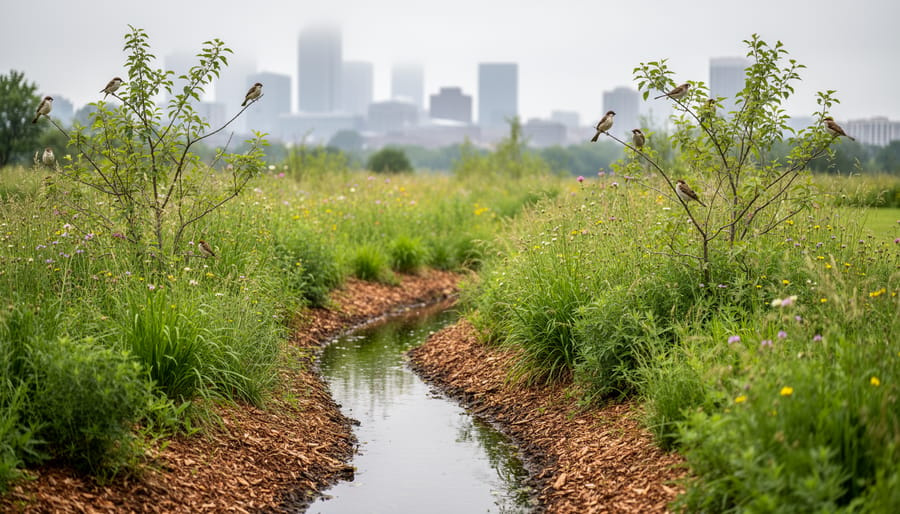
Urban ecosystem restoration transforms degraded city spaces into functioning natural habitats by reintroducing native plants, improving soil and water quality, and creating corridors for wildlife. These projects reverse decades of environmental damage in parks, waterways, brownfields, and even roadside strips, delivering measurable benefits including reduced urban heat, improved air quality, enhanced stormwater management, and increased biodiversity. The process begins with ecological assessment, followed by removal of invasive species, soil remediation, strategic planting of native vegetation, and long-term monitoring to ensure resilience.
Cities have spent centuries paving over wetlands, channeling rivers into concrete, and replacing diverse ecosystems with monoculture lawns. That legacy shows up in flash flooding, polluted runoff, heat islands that spike summer temperatures by 15 degrees or more, and the near-total absence of birds, pollinators, and other wildlife from urban cores. Urban ecosystem restoration reverses this trajectory by rebuilding the ecological infrastructure that cities need to function sustainably.
The stakes extend beyond aesthetics. Restored urban ecosystems provide essential services: they filter pollutants from stormwater before it reaches rivers and lakes, sequester carbon, buffer communities against climate extremes, and offer residents access to nature that improves mental and physical health. Research consistently shows that restored green spaces reduce neighborhood temperatures, lower energy costs, increase property values, and support community cohesion.
What makes urban restoration different from traditional conservation is the context. Projects must account for contaminated soils, fragmented landscapes, intensive human use, and limited budgets. Success requires collaboration among municipal agencies, environmental nonprofits, academic researchers, and community members who bring local knowledge and long-term stewardship. The most effective initiatives don’t just restore ecological function. They also create spaces where people can connect with nature, building the constituency needed to protect these restored ecosystems for generations.
Why Urban Ecosystems Need Restoration
Cities weren’t designed with ecosystems in mind. For most of the 20th century, urban development prioritized efficiency and growth over environmental function, and we’re living with the consequences. The natural systems that once filtered water, cooled the air, and supported diverse species have been paved over, channeled underground, or fragmented beyond recognition.
The result is a cascade of interconnected problems that undermine urban resilience:
- Habitat fragmentation isolates wildlife populations and prevents natural migration patterns
- Impervious surfaces like asphalt and concrete block water absorption, sending polluted runoff into waterways and increasing flood risk
- Urban heat islands form when dark surfaces absorb and radiate heat, raising temperatures 2-7°F above surrounding areas
- Degraded water quality stems from sediment, chemicals, and debris washing directly into streams without natural filtration
- Native species disappear as invasive plants dominate and critical food sources vanish
- Air pollution concentrates without vegetation to capture particulates and produce oxygen
These aren’t isolated issues. The same parking lot that creates runoff problems also intensifies heat, eliminates habitat, and degrades air quality. Traditional gray infrastructure, built to move water away quickly through pipes and drains, has failed to address the root cause: cities have severed the natural processes that once regulated temperature, managed stormwater, and sustained life.
The urban land cover effects demonstrate how replacing vegetation with buildings and pavement fundamentally alters local environmental conditions. Every tree removed, wetland filled, or stream buried compounds the problem. After decades of this pattern, many cities now face flooding during storms, dangerous heat during summers, and chronic pollution year-round.
What’s often overlooked is that cities still depend on functioning ecosystems. They need soil to absorb water, plants to filter air and cool surfaces, and green corridors to support pollinators and other species that maintain ecological balance. Restoration isn’t about returning to some pre-urban wilderness. It’s about rebuilding the natural infrastructure that makes cities livable and resilient in the face of growing environmental pressures.
Core Components of Urban Restoration Projects
Native Habitat Reconstruction
Reestablishing native plant communities forms the backbone of urban habitat reconstruction. Science-backed restoration begins with assessing which species historically thrived in the area before development altered the landscape. Practitioners then systematically remove invasive plants that outcompete natives and degrade ecosystem function, replacing them with locally adapted species that support regional wildlife and require minimal irrigation once established.
Soil rehabilitation runs parallel to planting efforts. Urban soils typically suffer from compaction, contamination, and depleted organic matter after years of disturbance. Restoration teams incorporate compost, break up hardpan layers, and sometimes remove polluted soil entirely, creating conditions where native root systems can penetrate deeply and store carbon effectively.
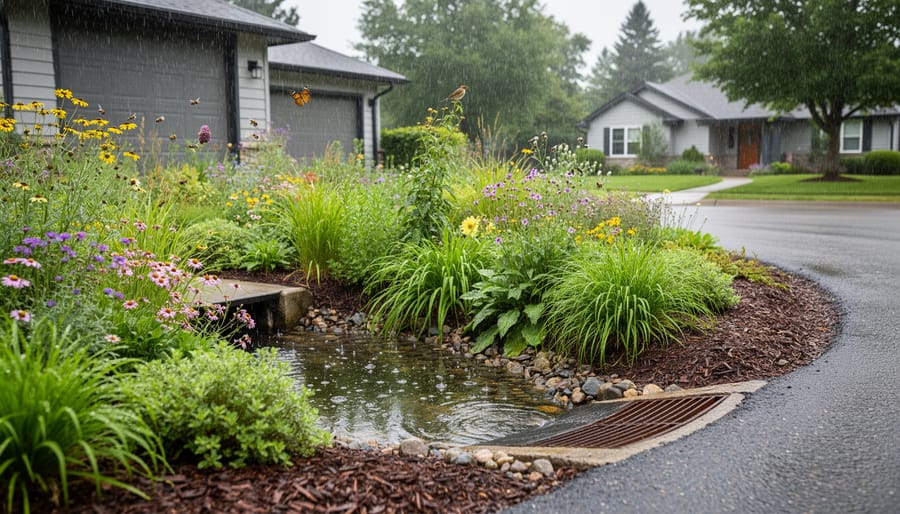
Strategic techniques translate ecological goals into functional urban landscapes. Bioswales, shallow, vegetated channels, capture and filter stormwater while supporting native grasses and wildflowers. Rain gardens serve similar functions in smaller spaces, transforming problem drainage areas into habitat patches. Urban forests provide canopy cover that reduces heat island effects while creating vertical structure for birds and beneficial insects. Wildlife corridors connect these scattered green spaces, allowing species to move between habitat patches rather than isolating populations in ecological islands. Each technique serves multiple purposes: managing water, cooling neighborhoods, sequestering carbon, and supporting biodiversity that cities have displaced.
Water System Rehabilitation
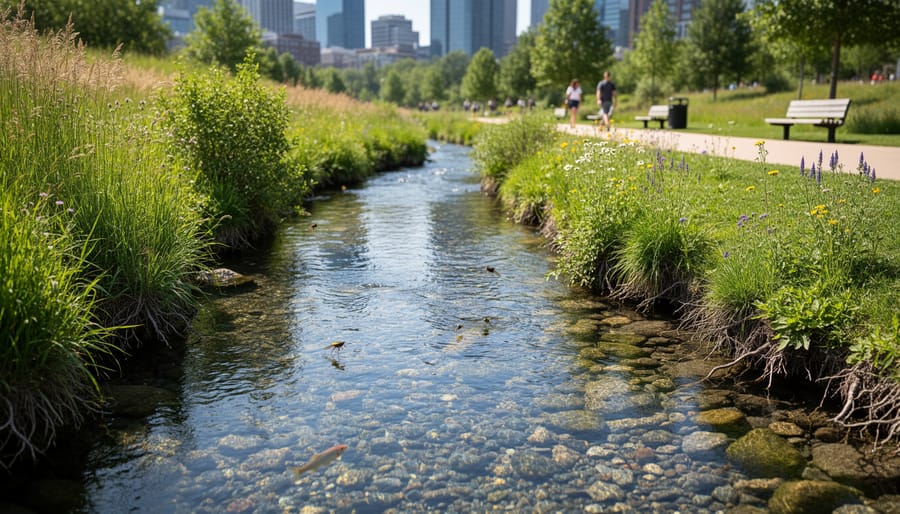
Urban waterways form the circulatory system of healthy cities, yet decades of development have turned many into underground pipes and concrete channels. Water system rehabilitation reverses that damage by restoring natural hydrology and ecological function to degraded urban waterways.
Daylighting buried streams represents one of restoration’s most transformative interventions. This process removes concrete culverts and channels to expose historically buried waterways, reconnecting them with riparian corridors and floodplains. Once exposed, these streams can filter pollutants, support aquatic life, and provide natural flood control instead of simply funneling stormwater to overwhelmed treatment systems.
Wetland restoration tackles water quality at the source. Urban wetlands act as biological filters, removing heavy metals, nutrients, and sediments from runoff before they reach rivers and lakes. Projects often reconstruct historic wetlands that were filled for development, creating shallow basins with native vegetation that slow and clean stormwater while providing habitat for amphibians, birds, and beneficial insects.
Riparian zone rehabilitation focuses on the vegetated interfaces between land and water. Planting native trees, shrubs, and grasses along streambanks stabilizes soil, reduces erosion, cools water temperatures for fish survival, and creates wildlife corridors through urban areas. These buffers also filter agricultural and lawn chemicals before they enter waterways.
Green infrastructure complements physical restoration by managing stormwater where it falls. Bioswales, permeable pavements, and constructed wetlands capture runoff at street level, allowing gradual infiltration rather than overwhelming storm drains during heavy rain events.
Community Integration and Engagement
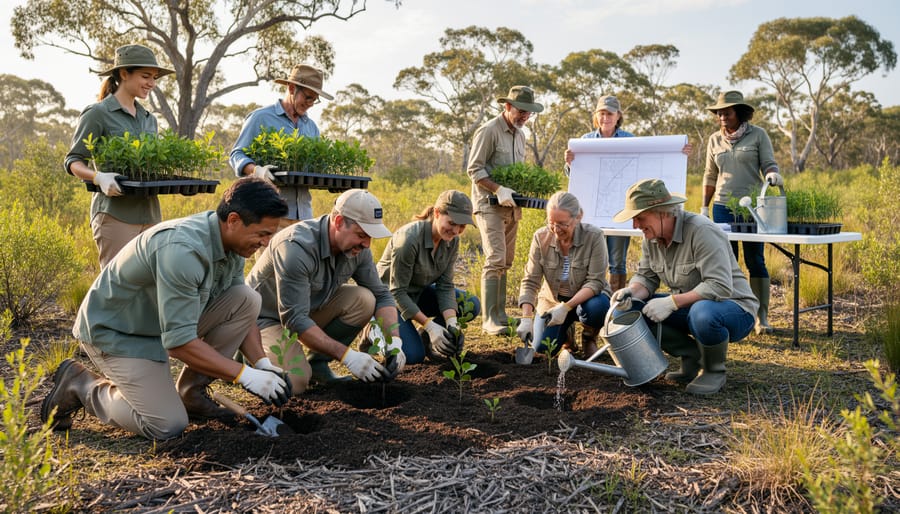
Urban ecosystem restoration succeeds when communities become active partners rather than passive beneficiaries. Projects that integrate residents from initial planning through long-term stewardship generate stronger outcomes and deeper local investment in restored landscapes.
Meaningful participation starts with inclusive planning processes that seek input from diverse neighborhood voices, particularly communities historically excluded from environmental decision-making. Restoration teams that conduct listening sessions, distribute multilingual surveys, and host walk-through events ensure designs reflect actual community priorities, whether that’s shade trees near playgrounds, native pollinator gardens, or accessible walking paths through restored wetlands.
Implementation offers hands-on engagement opportunities. Volunteer planting days, stream cleanup events, and invasive species removal workshops transform residents into ecological stewards while building environmental literacy. Education programs tailored to different audiences, from elementary school field trips to adult water education workshops, strengthen understanding of local ecosystems and restoration techniques.
Long-term engagement requires deliberate equity considerations. Restored green spaces must be genuinely accessible to nearby residents through safe pedestrian connections, culturally responsive programming, and active outreach to underserved populations. Community stewardship programs that offer stipends or job training create pathways for sustained participation beyond initial project completion. When restoration becomes community-driven rather than merely community-adjacent, sites gain dedicated advocates who monitor progress, report maintenance needs, and champion expanded restoration efforts citywide.
The Restoration Process: From Assessment to Monitoring
Urban ecosystem restoration follows a structured yet adaptive process that typically spans years, not months. Understanding these phases helps demystify how degraded sites transform into thriving green infrastructure. While each project differs based on site conditions and community needs, most follow a consistent framework that balances scientific rigor with practical constraints.
The journey begins with a baseline ecological assessment. Restoration ecologists survey the site to document existing vegetation, soil conditions, hydrology patterns, wildlife presence, and contamination levels. This assessment identifies both problems and opportunities, perhaps a buried creek that could be daylighted, or remnant native plants that indicate what once thrived there. Simultaneously, teams review historical records, old maps, and photographs to understand the site’s ecological history before development altered it.
- Baseline ecological assessment: Document current site conditions, vegetation, soil quality, hydrology, wildlife presence, and contamination levels while researching historical ecology.
- Goal-setting and design: Define measurable restoration targets based on assessment findings, establish success criteria, and create detailed plans for habitat reconstruction and infrastructure.
- Community consultation: Engage local residents, businesses, and stakeholders to incorporate their needs, build support, and identify volunteer opportunities.
- Implementation and construction: Execute the physical restoration work including earth-moving, planting, infrastructure installation, and invasive species removal.
- Establishment period maintenance: Provide intensive care during the critical first two to three years through regular watering, weeding, replanting, and protecting young vegetation.
- Long-term monitoring and adaptive management: Track ecological indicators against success criteria, adjust strategies based on results, and transition to sustainable maintenance protocols.
The design phase translates assessment findings into actionable plans. Restoration teams set specific, measurable goals rather than vague aspirations. Instead of “improve biodiversity,” a project might target “establish 15 native plant species with 70% survival after three years” or “reduce stormwater runoff by 40%.” Engineers and landscape architects create detailed plans showing where native plantings will go, how stormwater features will function, and what infrastructure changes are needed.
Community consultation isn’t a checkbox exercise but an ongoing dialogue. Residents know the site’s challenges, where flooding occurs, which areas feel unsafe, what the neighborhood needs. Their input shapes design decisions and builds the local investment necessary for long-term success. This phase also identifies potential volunteers and creates educational programming around the restoration.
Implementation transforms plans into reality. Heavy machinery may reshape the land, remove invasive species, or install bioswales and rain gardens. Native plants go into carefully prepared soil. Depending on project scale, this phase lasts weeks to months and requires coordination among contractors, volunteers, and municipal services.
The establishment period demands patience. Newly planted ecosystems are fragile. For two to three years, sites need regular watering during dry spells, weeding to prevent invasives from returning, and replacement planting where initial efforts fail. This intensive care determines whether the investment succeeds or the site reverts to degradation.
Monitoring continues indefinitely, though intensity decreases as the ecosystem matures. Teams track whether targets are being met, measuring plant survival, wildlife usage, water quality improvements, and community engagement. When monitoring reveals problems or opportunities, adaptive management allows course corrections. A restoration isn’t static, it evolves as the ecosystem responds and climate conditions shift.
Measuring Success: Environmental and Social Outcomes
Evaluating urban restoration projects requires tracking both ecological recovery and tangible human benefits. Environmental metrics provide the scientific foundation: biodiversity indices measure whether native species populations are rebounding, water quality testing tracks reductions in pollutants and sediment loads, carbon sequestration calculations quantify the climate mitigation value of restored vegetation, and temperature sensors document cooling effects that reduce urban heat island intensity. Together, these indicators reveal whether natural systems are regaining their functional capacity.
The social outcomes of restoration often prove just as compelling as ecological gains. Public health studies consistently link proximity to restored green spaces with reduced stress levels, improved air quality, and increased physical activity among nearby residents. Communities gain new recreational opportunities and educational settings where residents can observe wildlife, learn about native ecosystems, and understand their role in environmental stewardship. The return of keystone species like pollinators signals ecosystem health while providing visible signs of success that engage the public.
Economic and safety benefits extend the case for restoration beyond environmental advocacy. Property values in neighborhoods adjacent to well-maintained restored areas typically see measurable increases, while green infrastructure components reduce flood risk by absorbing stormwater that would otherwise overwhelm conventional drainage systems. These dual measurement frameworks ensure restoration projects deliver value across environmental justice, public safety, and economic dimensions rather than serving as isolated ecological exercises.
Overcoming Common Challenges
Urban restoration projects confront a constellation of practical challenges, yet documented successes show that strategic approaches can turn these obstacles into opportunities for innovation and collaboration.
Funding represents perhaps the most persistent barrier. Restoration initiatives typically require substantial upfront investment with environmental benefits that accrue over years, creating a mismatch with traditional budget cycles. Successful projects address this through diversified financing models that blend public grants, philanthropic support, private investment in green infrastructure, and community fundraising. Payment for ecosystem services programs, where downstream communities pay for upstream restoration that improves their water quality, demonstrate how framing restoration as infrastructure investment rather than environmental amenity opens new funding streams.
Land ownership and permitting complexity can stall even well-designed projects. Urban sites often involve multiple property owners, overlapping jurisdictions, and regulatory requirements from numerous agencies. The most effective approach combines early stakeholder mapping with transparent communication. Engaging all parties during initial planning, rather than seeking permission after designs are finalized, builds coalitions that navigate bureaucratic processes more smoothly. Securing temporary conservation easements while working toward permanent protections allows projects to proceed while complex legal arrangements are finalized.
Public expectations about restoration timelines frequently create tension. Communities accustomed to instant landscaping expect immediate results, while ecological restoration unfolds across decades. Managing these expectations requires honest communication about restoration phases, celebrating early wins like pollinator gardens while explaining that canopy development takes years, and providing visible progress markers. Interpretive signage describing what restored sites will become helps visitors appreciate young ecosystems.
Competing land use pressures intensify in dense urban areas where every parcel faces multiple potential uses. Demonstrating that restoration delivers tangible community benefits, flood protection, recreational space, urban cooling, frames these projects as multipurpose investments rather than single-use conservation. Incorporating walking paths, outdoor classrooms, and community gathering spaces into restoration designs shows how ecological function and human use can coexist.
Long-term maintenance funding often receives less attention than initial implementation, yet determines ultimate success. Building stewardship into project design from the outset, recruiting volunteer steward networks, and securing endowments or dedicated municipal budgets for ongoing care prevents restored sites from degrading after ribbon-cutting ceremonies end.
Climate uncertainty complicates planning when temperature and precipitation patterns are shifting. Forward-thinking projects incorporate climate projections into species selection, choose diverse plant palettes rather than relying on single species, and design systems with flexibility to adapt as conditions change.
How You Can Support Urban Restoration
Urban restoration thrives when communities actively participate. Start at the local level by joining restoration workdays in your neighborhood parks, wetlands, or stream corridors. These hands-on opportunities teach practical skills while directly improving your community’s environmental health. Many cities post volunteer schedules through parks departments or environmental nonprofits, making it easy to become a volunteer on projects that fit your schedule and interests.
Transform your own property into a restoration site, however small. Replace lawn areas with native plant gardens that provide habitat and manage stormwater naturally. Even a few square feet of native wildflowers or shrubs supports pollinators and reduces runoff. Connect with local native plant societies for species recommendations suited to your specific conditions.
Advocate for restoration-friendly policies in your community. Attend city council meetings to support green infrastructure funding, tree canopy goals, and development standards that protect existing ecosystems. Write to decision-makers requesting restoration projects in underserved neighborhoods where residents face the greatest environmental burdens. This climate accountability ensures restoration resources reach communities most in need.
Support organizations advancing restoration science and practice. Donations fund research into effective techniques, community engagement programs, and long-term site monitoring that validates restoration outcomes. Organizations like CERI translate scientific findings into actionable restoration strategies that cities worldwide can implement.
Educate yourself and others about restoration’s multiple benefits. Share success stories, invite neighbors to site visits, and counter misconceptions that portray restoration as limiting recreation or development. The more people understand restoration’s role in livable cities, the stronger public demand becomes for ambitious projects.
Frequently Asked Questions
Urban ecosystem restoration raises practical questions for anyone considering involvement in or support of these initiatives. Understanding the realities of timelines, scale, and long-term stewardship helps set realistic expectations while recognizing the genuine impact these projects deliver.
How long do urban restoration projects take to show results?
Initial improvements like reduced runoff and cooler surface temperatures often appear within the first growing season as vegetation establishes, while more complex outcomes such as mature forest canopy or stable wildlife populations typically require five to fifteen years of sustained management.
Can small-scale restoration efforts make a meaningful difference?
Absolutely. Even modest projects like converting a parking strip to native plantings or restoring a single stream segment create wildlife habitat, improve local water quality, and demonstrate approaches that can scale across a city when multiplied through community action.
What distinguishes restoration from conservation?
Conservation focuses on protecting existing healthy ecosystems from degradation, while restoration actively rehabilitates ecosystems that have already been damaged or destroyed, working to rebuild ecological function in degraded urban landscapes.
How are restored sites maintained after the initial project phase?
Successful projects establish long-term stewardship plans that combine trained volunteers, municipal staff, and specialized contractors to handle tasks like invasive species monitoring, plant replacement, infrastructure maintenance, and adaptive management as conditions change.
How does climate change factor into restoration planning?
Contemporary projects select plant species and design infrastructure to withstand projected temperature ranges, precipitation patterns, and extreme weather events for the coming decades rather than relying solely on historical climate data, building resilience into restoration from the start.
The timeline question matters because restoration is not instantaneous greening. Fast-growing native perennials and grasses stabilize soil and filter water within months, providing immediate functional benefits. Trees, wetland systems, and established wildlife corridors mature over years, with ecological complexity deepening as species interactions develop and soil structure rebuilds. Setting a realistic timeframe prevents discouragement while maintaining the commitment needed for substantive ecological recovery.
Scale concerns often stop potential participants before they start, yet cumulative small actions genuinely shift urban landscapes. A block’s worth of rain gardens reduces combined sewer overflow events. Corridor plantings along residential streets provide stepping-stone habitat that connects larger parks. These distributed interventions, replicated across neighborhoods, create resilient networks more effective than isolated flagship projects alone. The question is not whether your contribution is big enough, but whether it is strategic enough to connect with broader restoration efforts.
Urban ecosystem restoration has moved from an aspirational concept to an environmental imperative. As cities face mounting pressures from climate change, population growth, and infrastructure strain, restoring degraded ecosystems isn’t just about beautification. It’s about survival. These projects deliver tangible returns: cooler neighborhoods during heat waves, reduced flood risk during storms, cleaner air for children to breathe, and habitats that support the biodiversity our planet desperately needs.
The evidence is clear. Restored urban ecosystems strengthen climate resilience, improve public health outcomes, and advance environmental justice by prioritizing communities historically excluded from green space planning. Every restored wetland, reforested park, and daylighted stream represents an investment that compounds over time, creating healthier, more equitable cities for generations.
This work demands action at every level. Policymakers must embed restoration priorities into urban planning and infrastructure budgets. Developers and landowners can integrate green infrastructure from the outset rather than as an afterthought. Community members hold power through advocacy, volunteerism, and holding leaders accountable to environmental commitments.
Organizations like the Centre for Ecosystem Restoration Innovation continue advancing the science and practice of urban restoration, developing evidence-based approaches that communities worldwide can adopt. Their work demonstrates that restoration succeeds when it combines ecological rigor with genuine community partnership.
The question isn’t whether your city needs ecosystem restoration. It’s whether you’ll help make it happen. Engage with restoration initiatives in your area. Support policies that prioritize nature-based solutions. Demand that environmental considerations shape development decisions. The cities we need won’t emerge from inaction. They’ll grow from deliberate choices to restore what we’ve degraded and protect what remains.