

Climate accountability is the system through which governments, corporations, and institutions are monitored and compelled to meet their climate commitments. It operates through legal frameworks, transparent reporting requirements, enforcement mechanisms, and public oversight that together determine whether climate promises translate into measurable emissions reductions.
Without accountability, climate pledges remain aspirational. The Canadian Net-Zero Emissions Accountability Act, which became law in 2021, exemplifies how nations are embedding transparency into climate policy by requiring the federal government to set targets, track progress, and publicly report outcomes on the path to net-zero emissions by 2050. Similar frameworks worldwide establish who must act, what they must achieve, and how their performance will be verified.
The challenge lies in closing the gap between commitment and action. While Canada has pledged to meet and exceed its 2030 targets under the Paris Agreement and has introduced initiatives like the Climate Competitiveness Strategy announced in Budget 2025, accountability depends on robust monitoring, enforceable standards, and consequences for inaction. These mechanisms must answer critical questions: Are emissions actually falling? Who faces penalties for non-compliance? How can citizens verify progress?
Climate accountability matters because it transforms political statements into binding obligations. It gives communities legal standing to challenge inadequate climate action, requires polluters to disclose their environmental impact, and creates feedback loops that pressure decision-makers to strengthen policies when progress stalls. Understanding how these systems work empowers you to participate in holding power to account, whether through advocacy, legal channels, or informed civic engagement that demands more than promises.
What Climate Accountability Means in Practice
Climate accountability operates as a system where promises meet performance through measurable verification. At its core, it’s the framework ensuring governments and corporations can’t simply announce ambitious climate targets without demonstrating real progress or facing consequences when they fall short.
The concept rests on three pillars working together. Transparency means making climate commitments, emissions data, and progress visible to the public through standardized reporting. Measurability requires tracking emissions and actions against specific targets using consistent methodologies. Enforcement creates consequences, legal, financial, or reputational, when actors fail to meet their obligations.
Consider how this works with the Paris Agreement. Countries submit nationally determined contributions outlining their emission reduction targets. They then report progress through biennial transparency reports and national inventory reports under the United Nations Framework Convention on Climate Change. This creates a public record that researchers, journalists, and citizens can scrutinize. When governments miss targets or backtrack on commitments, they face pressure from international peers, domestic lawsuits, and public accountability.
In Canada, the Canadian Net-Zero Emissions Accountability Act (assented to in 2021) exemplifies this framework by requiring the government to set five-year emissions reduction targets, report progress publicly, and justify how policies align with reaching net-zero by 2050. The law doesn’t just state an aspiration, it creates legally binding timelines and transparency requirements that enable oversight bodies and citizens to verify whether Canada is actually delivering on its climate promises or simply announcing them.
Legal and Policy Frameworks Driving Accountability

National Climate Laws
Countries translate climate commitments into enforceable action by embedding targets, transparency requirements, and reporting obligations directly into domestic law. National climate legislation transforms international pledges into binding legal frameworks that governments must follow, creating clear accountability structures backed by statutory authority.
Canada’s approach exemplifies this legislative model. The Canadian Net-Zero Emissions Accountability Act, which became law in 2021, establishes legally binding requirements for achieving net-zero greenhouse gas emissions by 2050. The Act mandates that the federal government set emission reduction targets for specific milestone years and develop credible, detailed plans to achieve them. These aren’t aspirational goals, they’re legal obligations that require concrete action.
Transparency sits at the core of effective climate laws. The Accountability Act transparency duties require the government to publish progress reports showing whether Canada is on track to meet its targets. This public disclosure creates accountability pressure by making government performance visible to citizens, researchers, and advocacy organizations who can assess whether commitments match reality.
Timeline commitments embedded in climate laws create structured accountability intervals. Canada has committed to achieving and exceeding its 2030 target under the Paris Agreement, with the government required to demonstrate progress through regular reporting cycles. By March 31, 2026, Environment and Climate Change Canada must complete risk classifications for all its laws, regulations, and enforceable instruments, a systematic accountability measure that ensures climate policies receive proper oversight.
Recent policy evolution shows how climate laws adapt to economic realities while maintaining accountability. Budget 2025 introduced the Climate Competitiveness Strategy, signaling a new approach that supports regionally responsive implementation and catalyzes private sector investment in decarbonization. This framework demonstrates that climate accountability legislation can balance environmental targets with economic competitiveness, creating enforcement structures that drive action without compromising innovation.
International Agreements and Reporting
International agreements create climate accountability by establishing standardized reporting systems that make national progress measurable and comparable. Under the Paris Agreement, countries submit nationally determined contributions outlining their emission reduction targets and implementation strategies. These commitments form the foundation for tracking whether nations are delivering on their promises.
The accountability mechanism relies on transparency through three core reporting instruments. Countries must submit national inventory reports detailing annual greenhouse gas emissions across all sectors, biennial transparency reports on progress toward their targets, and updated nationally determined contributions every five years with increasingly ambitious goals. Canada has international reporting obligations under the United Nations Framework Convention on Climate Change covering all these requirements.
The Paris transparency review process adds teeth to these obligations through technical expert review, where independent assessors examine each country’s reports for completeness and accuracy. This peer review mechanism creates accountability pressure by publicly identifying gaps between commitments and actual progress, driving international policy reform when shortfalls become evident across multiple nations.
How Governments Are Held Accountable
Regulatory Compliance and Risk Classification
Environmental agencies have developed systematic processes to ensure climate regulations are monitored and enforced. At the core of these processes is risk classification, a method that categorizes laws, regulations, and enforceable instruments based on their potential environmental impact and the likelihood of non-compliance.
In Canada, Environment and Climate Change Canada applies risk classification to all climate-related regulatory instruments. The agency assesses each law or regulation based on factors like the severity of potential environmental harm, historical compliance patterns, and the resources required for monitoring. High-risk regulations, those governing major industrial emitters or critical environmental thresholds, receive more frequent inspections, stricter reporting requirements, and greater enforcement scrutiny.
By March 31, 2026, 100% of Environment and Climate Change Canada laws, regulations, and enforceable instruments must have completed risk classifications. This comprehensive assessment creates a roadmap for allocating enforcement resources where they matter most and identifies regulatory gaps that could allow climate commitments to slip through cracks.
Risk classification isn’t just administrative bookkeeping. It transforms vague climate promises into prioritized enforcement action by identifying which regulations require the most vigilant oversight and which compliance failures pose the greatest threat to meeting national targets like Canada’s 2030 Paris Agreement commitments.
Independent Oversight and Public Reporting
Independent oversight bodies and mandatory reporting requirements create crucial transparency mechanisms that transform climate commitments from aspirational statements into measurable obligations. In Canada, the Canadian Net-Zero Emissions Accountability Act, passed in 2021, established a legal framework requiring the federal government to set five-year emissions reduction targets, develop credible climate plans, and publish progress reports assessing whether the country is on track to meet its commitments. These reports must be tabled in Parliament, creating a public record that citizens, researchers, and advocacy organizations can scrutinize.
Advisory bodies play a complementary role by providing independent analysis that enhances government accountability. These expert panels assess the adequacy of proposed measures, evaluate scientific evidence, and often issue public recommendations that governments must formally respond to. When these advisory opinions contradict government claims about progress, they create political pressure and provide credible ammunition for civil society groups demanding stronger action. The requirement to respond publicly to independent assessments makes it harder for governments to quietly abandon commitments or misrepresent their performance.
Litigation and Legal Action
Climate litigation has emerged as a powerful accountability mechanism where legal systems failed to protect. Courts worldwide now hear constitutional challenges arguing governments violated fundamental rights to life, health, and a stable environment by inadequate climate action. In Canada, youth-led cases claim federal climate plans breach Charter protections and intergenerational duty-of-care obligations. European courts have ordered nations to accelerate emissions cuts after finding governments breached human rights treaties. These lawsuits don’t just seek declarations, they demand enforceable timelines and specific policy changes. The threat of judicial intervention creates accountability pressure beyond voluntary commitments, forcing governments to justify inaction against legal standards rather than political convenience.
Holding Polluters and Corporations Accountable
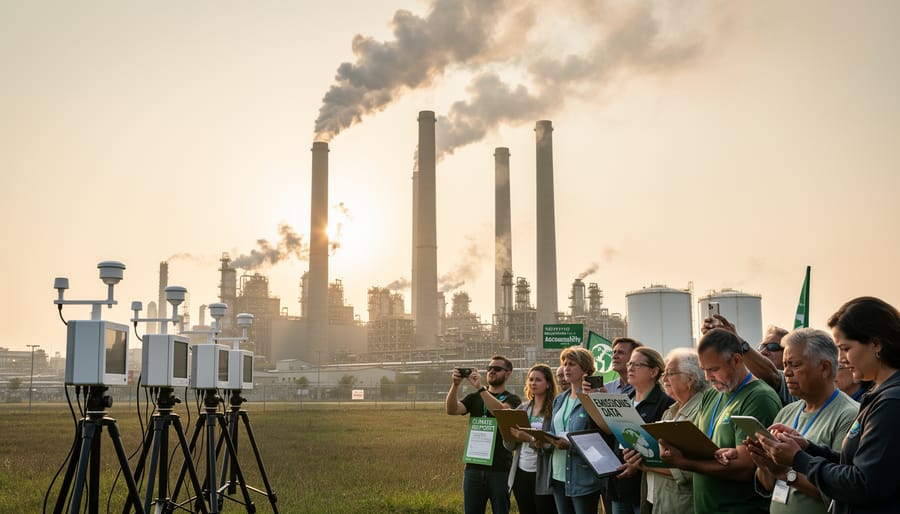
Mandatory Emissions Reporting and Disclosure
Corporate emissions reporting requirements serve as a critical transparency mechanism, forcing companies to measure, document, and publicly disclose their greenhouse gas emissions and climate-related financial risks. These mandatory disclosure systems transform climate accountability from voluntary pledges into documented records that investors, regulators, and the public can scrutinize.
Modern reporting frameworks typically require companies to disclose three categories of emissions: direct emissions from operations (Scope 1), indirect emissions from purchased energy (Scope 2), and value chain emissions from suppliers and customers (Scope 3). This comprehensive approach prevents companies from hiding their true climate impact by focusing only on direct operations while ignoring their supply chain footprint.
Financial disclosure requirements have evolved beyond emissions counts to include climate risk assessments. Companies must now report how climate change threatens their business model, what transition risks they face as regulations tighten, and how physical climate impacts could damage assets or disrupt operations. This information allows investors to price climate risk into their decisions and creates market pressure for genuine climate action rather than greenwashing.
Standardized reporting formats enable meaningful comparison across companies and sectors. When all firms report using the same methodologies and boundaries, stakeholders can identify industry laggards, reward leaders, and track whether corporate climate commitments translate into actual emissions reductions over time.
Economic Instruments and Regulatory Penalties
Economic instruments create direct financial consequences for emissions, transforming climate accountability from voluntary commitments into economic reality. When polluters face real costs for carbon emissions, accountability shifts from moral obligation to business calculation.
Carbon pricing mechanisms put a price on greenhouse gas emissions, making pollution expensive and clean alternatives competitive. Companies burning fossil fuels or releasing industrial emissions pay per tonne of carbon dioxide equivalent they emit. This cost structure incentivizes emission reductions, energy efficiency investments, and cleaner technology adoption. The price signal travels through supply chains, influencing decisions from energy procurement to product design.
Cap-and-trade systems set absolute limits on emissions within a jurisdiction, creating a finite pool of emission allowances that companies must acquire to operate. As the cap tightens over time, emission permits become scarcer and more valuable. Companies that reduce emissions below their allocation can sell surplus permits; those exceeding limits must purchase additional allowances or face penalties. This market mechanism rewards early action and efficient reductions while maintaining overall emission limits.
Regulatory penalties enforce compliance with emission limits and reporting requirements. Companies failing to meet reduction targets, submit mandatory disclosures, or adhere to sectoral emission standards face financial penalties scaled to the severity and duration of non-compliance. These consequences create accountability for specific regulatory obligations, not just voluntary goals.
The Climate Competitiveness Strategy announced in Budget 2025 signals evolving approaches to economic accountability instruments that maintain emission reduction pressure while supporting industry transition and competitiveness in a decarbonizing global economy.
Current Policy Approaches and Innovation
Canada’s climate accountability framework is entering a new phase that recognizes enforcement must work alongside economic reality. Environment and Climate Change Canada has identified accelerating clean growth through regionally responsive climate policy as a key priority for 2026-27, signaling a shift from one-size-fits-all mandates toward approaches that account for provincial variations in energy systems, industrial bases, and transition challenges.
This evolution acknowledges a practical tension: strict accountability mechanisms can fail if they ignore competitiveness pressures or regional economic contexts. The Climate Competitiveness Strategy, announced in Budget 2025, represents this recalibrated approach, building accountability structures that enhance Canada’s position in the net-zero global economy rather than treating climate action and economic strength as competing priorities.
The strategy prioritizes catalyzing private sector investment and innovation in decarbonization and clean technologies, moving beyond purely regulatory compliance toward systems that make low-carbon choices economically advantageous. This includes accountability measures that reward early movers, penalize laggards, but maintain flexibility for industries facing genuine transition constraints.
Regionally responsive implementation means accountability metrics might differ between provinces heavily dependent on fossil fuel extraction and those with established clean energy infrastructure, while maintaining the same national emissions reduction targets. The framework creates space for provinces to meet obligations through pathways suited to their economic structures, provided they demonstrate measurable progress and transparent reporting.
Operationally, this approach requires more sophisticated monitoring. Environment and Climate Change Canada must complete risk classifications for 100% of its laws, regulations, and enforceable instruments by March 31, 2026, a massive undertaking that will categorize climate policies by their compliance risk and enforcement priority, enabling more strategic resource allocation toward high-impact accountability measures.
These innovations don’t weaken accountability; they make it more durable by embedding it within economic incentives rather than relying solely on penalties and mandates.
Challenges in Climate Accountability

Despite progress in establishing climate accountability frameworks, significant obstacles persist that weaken enforcement and delay meaningful action. Understanding these challenges reveals why closing the gap between climate commitments and outcomes remains difficult.
Enforcement gaps create perhaps the most fundamental problem. While countries like Canada have passed legislation like the Canadian Net-Zero Emissions Accountability Act, many accountability frameworks lack binding consequences for missing targets. Governments can set ambitious goals without facing legal penalties for falling short, transforming accountability measures into aspirational statements rather than enforceable obligations. This creates a system where political pressure and public scrutiny often matter more than regulatory teeth.
Jurisdictional complexity compounds enforcement difficulties. Climate change crosses borders, but accountability systems remain largely national or regional. Provinces, territories, and municipalities may have climate plans that conflict with federal targets, creating implementation confusion. International agreements depend on voluntary compliance, with limited mechanisms to compel nations to meet their nationally determined contributions.
Measurement and verification present technical hurdles. Accurately tracking emissions across entire economies requires sophisticated monitoring systems and standardized methodologies. Different sectors use varying measurement approaches, making comprehensive accountability difficult. The time lag between implementing policies and observing climate outcomes creates uncertainty about which measures work, allowing governments to claim progress while emissions continue rising.
Political resistance undermines long-term accountability. Climate commitments often extend beyond electoral cycles, making them vulnerable to policy reversals when governments change. Short-term economic concerns frequently overshadow climate priorities, particularly during economic downturns or energy crises.
Economic considerations add another layer of complexity. Industries argue that strict accountability measures threaten competitiveness, creating pressure to weaken enforcement. Budget constraints limit regulatory capacity for monitoring and enforcement activities.
Overcoming these barriers requires sustained political will, adequate funding for oversight bodies, standardized measurement protocols, and community action that maintains pressure on governments and corporations between election cycles. Recognition of these challenges helps advocates target reforms where they matter most.
How You Can Support Climate Accountability
Climate accountability doesn’t happen in boardrooms and legislatures alone, it requires sustained pressure and participation from informed citizens. You have more power to influence climate action than you might realize.
- Participate in public consultation processes. When governments propose new climate policies or regulations, they’re often required to solicit public input. Submit evidence-based comments, attend town halls, and bring data to support stronger accountability measures. Your input becomes part of the public record and can shape final policy design.
- Support strategic climate litigation. Organizations pursuing legal action against governments and corporations for climate failures need financial backing and public support. Consider donating to environmental legal funds or signing on as intervenors in cases that establish accountability precedents.
- Demand corporate transparency. As a consumer, investor, or employee, you can pressure companies to disclose their full emissions footprint and climate risks. Ask questions at shareholder meetings, choose companies with verified sustainability commitments, and call out greenwashing when you see it.
- Vote for climate-committed leaders. Research candidates’ track records on climate accountability, not just their promises. Look for those who support legally binding targets, transparent reporting, and independent oversight mechanisms.
- Join citizen monitoring efforts. Community-based monitoring projects track local pollution sources, verify corporate compliance, and document environmental impacts. Contributing your observations creates accountability pressure that regulatory agencies can’t ignore.
- Educate yourself and others. Stay informed about climate commitments your government and major local employers have made. Learn to use scholarly research to fact-check claims and share credible information that counters misinformation.
Accountability strengthens when people actively defend it. Your engagement signals to decision-makers that climate commitments matter and that failing to deliver will have consequences.
Frequently Asked Questions
Climate accountability raises practical questions about enforcement, verification, and real-world effectiveness. Understanding how these systems work helps citizens engage more meaningfully with climate policy and hold decision-makers to account.
Who has the authority to enforce climate commitments?
Climate commitments are enforced through multiple channels: national environmental agencies regulate domestic laws, independent oversight bodies monitor progress, courts adjudicate climate litigation, and international frameworks like the Paris Agreement create peer review mechanisms. In Canada, Environment and Climate Change Canada manages compliance with laws including the Canadian Net-Zero Emissions Accountability Act, which became law on June 29, 2021.
What happens when governments fail to meet their climate targets?
Consequences vary by jurisdiction and include legal challenges, political pressure, reputational damage, and potential international sanctions. Citizens increasingly use litigation to force government action, while transparency requirements expose shortfalls publicly, creating accountability pressure even where formal penalties are limited.
How can I verify my government’s climate progress?
Most countries publish progress reports through official channels, including nationally determined contributions and biennial transparency reports submitted under the United Nations Framework Convention on Climate Change. Independent climate advisory bodies also provide assessments, and civil society organizations often track and analyze government data to make it accessible to the public.
Are current climate accountability systems actually working?
Systems show mixed results: transparency has improved significantly, more countries have legally binding targets, and climate litigation is growing as an enforcement tool. However, gaps remain in enforcement mechanisms, many jurisdictions lack adequate penalties for non-compliance, and the time lag between policy implementation and measurable climate outcomes makes immediate effectiveness difficult to assess.
These questions highlight both the progress made in climate accountability and the ongoing challenges. New approaches continue to emerge, including Canada’s Climate Competitiveness Strategy announced in Budget 2025, which aims to support regionally responsive implementation while catalyzing private sector investment in decarbonization. As frameworks evolve, citizen engagement remains essential to ensuring accountability systems translate into real climate action.
Climate accountability bridges the gap between climate promises and meaningful action. The frameworks outlined above, from national legislation and international agreements to litigation, corporate disclosure, and citizen engagement, create multiple pressure points that transform commitments into consequences. When governments pass accountability laws, when courts rule in favour of climate protection, when corporations face mandatory reporting requirements, and when citizens demand transparent progress reports, the abstract goal of climate action becomes concrete and enforceable.
Yet accountability systems are only as strong as our collective willingness to use them. The most sophisticated transparency framework means nothing if the public doesn’t engage, if violations go unchallenged, and if political pressure fades between election cycles. Real climate accountability requires sustained attention: tracking whether leaders meet their targets, supporting organizations that file strategic litigation, demanding corporate climate disclosures, and voting for candidates committed to enforceable climate laws.
You have power in this system. Stay informed about your government’s progress toward its climate commitments. When consultation periods open for new climate regulations, participate. Support organizations working on climate enforcement and advocacy. Hold both governments and corporations to their climate promises, not through cynicism but through informed, persistent engagement. Climate accountability works when enough people refuse to let promises fade into forgotten announcements.