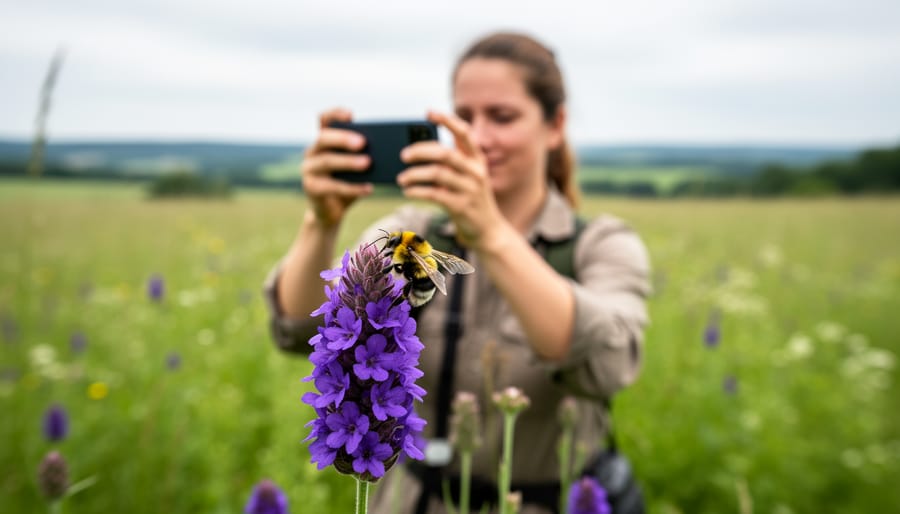
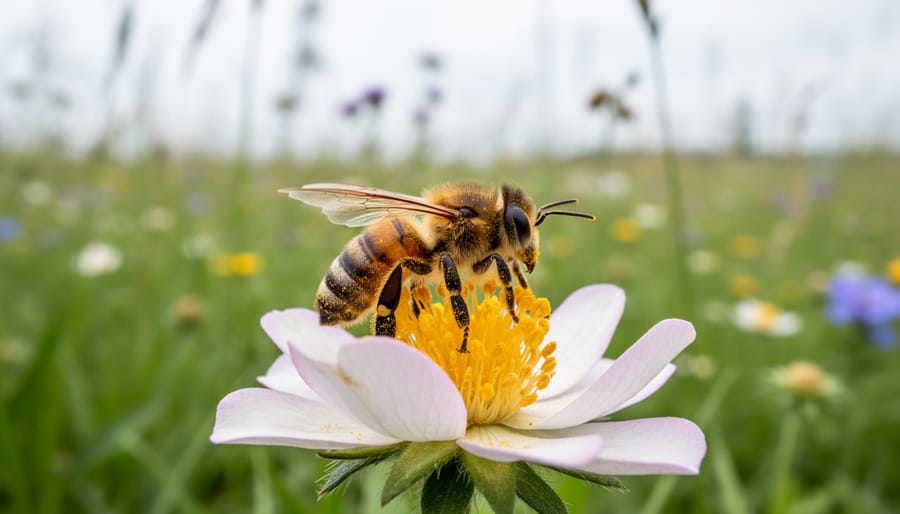
Bees are keystone species because their pollination services sustain entire ecosystems and food webs far beyond their own numbers. Remove bees from an ecosystem, and the cascading effects ripple through plant reproduction, herbivore populations, soil health, and even the predators that depend on those interconnected relationships. Like the keystone in an arch that holds all other stones in place, bees perform ecological functions so critical that their absence triggers systemic collapse.
The keystone species concept, introduced by ecologist Robert Paine in 1969, describes organisms whose impact on their ecosystem is disproportionately large relative to their abundance. Bees fit this definition perfectly. They pollinate approximately 75% of global food crops and 90% of wild flowering plants, supporting biodiversity that feeds countless other species. Without bee pollination, many plants fail to reproduce, depriving birds, mammals, and insects of food and habitat. The consequences extend to soil microbiomes, water filtration systems, and carbon sequestration processes that healthy plant communities provide.
Recent data from 2025 confirms what conservationists have warned about for years: bee populations continue declining at alarming rates due to habitat loss, pesticide exposure, climate disruption, and disease. Wild bee species face particularly severe threats, with some regional populations dropping by over 50% in the past two decades. These losses aren’t abstract statistics. They translate directly into reduced crop yields, diminished wildflower meadows, and weakened ecosystem resilience.
Understanding why bees qualify as keystone species isn’t merely academic. It clarifies where conservation efforts deliver the greatest ecological return and why protecting pollinators should rank among our highest environmental priorities. The evidence is clear, the mechanisms are well-documented, and the path forward demands both knowledge and action.
What Makes a Species ‘Keystone’
The term “keystone species” draws its name from architecture, specifically, the wedge-shaped stone at the apex of an arch that locks all other stones in place. Remove that single stone, and the entire structure collapses. In ecology, a keystone species plays the same stabilizing role: its presence maintains the structure and function of its ecosystem, even though it may represent only a small fraction of the total biomass or population.
Ecologists identify keystone species through several criteria. First, their removal triggers significant ecosystem changes, shifts in species composition, altered nutrient cycling, or even habitat transformation. Second, their impact extends across multiple trophic levels, affecting organisms they don’t directly interact with. Third, no other species can fully compensate for their ecological role if they disappear.
The designation isn’t about being the most numerous or largest organism. Prairie dogs, for instance, qualify as keystones not through sheer numbers but because their burrows create habitat for hundreds of other species and their grazing shapes plant communities across vast grasslands. Sea otters earn keystone status by controlling sea urchin populations, which in turn protects kelp forests that shelter countless marine species.
What matters is functional importance, the unique ecological role that ripples through the entire system. When a keystone species thrives, ecosystem diversity and stability tend to increase. When it declines, the effects cascade unpredictably, often leading to simplified ecosystems with fewer species and reduced resilience to environmental change.
How Bees Function as Ecosystem Keystones
Pollination Services That Sustain Plant Diversity
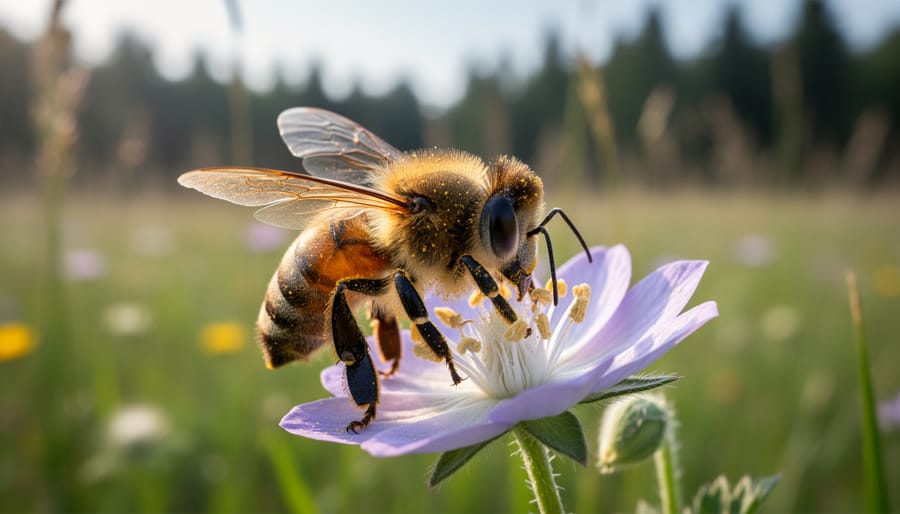
Approximately 90 percent of flowering plants depend on animal pollinators and bees perform the majority of this essential work. They visit thousands of plant species across virtually every terrestrial ecosystem, from alpine meadows to tropical forests. Without their pollination services, many plant communities would fragment into isolated patches dominated by wind-pollinated or self-fertile species, fundamentally altering habitat structure.
The scale of bee pollination extends well beyond agricultural crops. Native bees pollinate wildflowers that form the structural foundation of ecosystems, creating layers of vegetation that provide shelter, nesting sites, and microclimates for countless other organisms. When bee-pollinated flowering plants produce seeds, they sustain not only the next plant generation but also the birds, small mammals, and insects that depend on those seeds for food. A single healthy bee population can maintain the reproductive success of dozens of plant species in a localized area, which in turn supports an entire web of dependent organisms.
This pollination work also shapes ecosystem diversity through space and time. Bee-pollinated plants often bloom in succession throughout growing seasons, ensuring continuous nectar and pollen resources for other pollinators and insects. The resulting plant diversity creates heterogeneous habitats rather than monocultures, offering varied food sources, hiding places, and breeding grounds. When bee populations decline, this structural complexity often collapses first, simplifying habitats before other changes become visible. The cascading loss begins with reduced seed set in plants, followed by shifts in vegetation composition, then eventual impacts on animals higher up the food chain.
Supporting Food Webs and Wildlife Populations
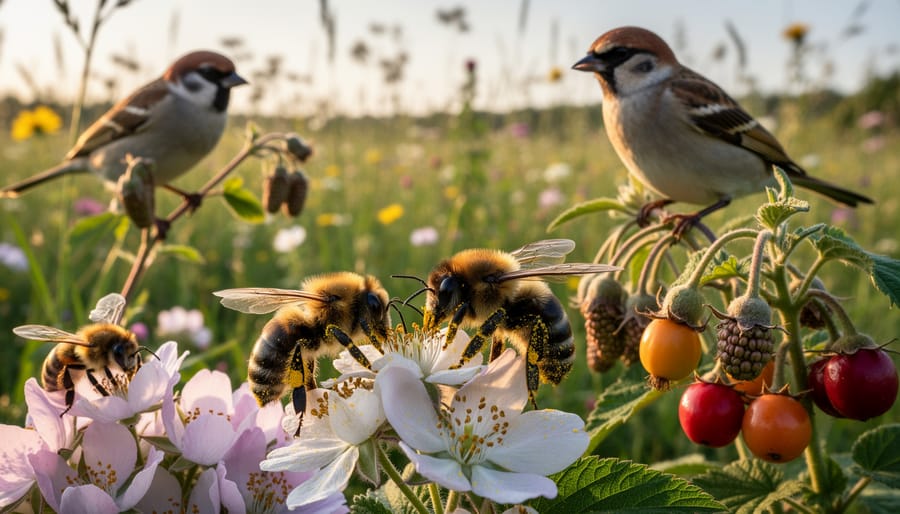
The fruits and seeds produced through bee pollination form the foundation of countless food webs, sustaining wildlife populations far beyond the plants themselves. Over 80% of wild flowering plants depend on animal pollinators, primarily bees, to produce the berries, nuts, and seeds that feed everything from songbirds to bears. When bees pollinate wildflowers and shrubs, they enable seed production that supports granivorous birds like finches and sparrows. These same plants produce berries consumed by migratory thrushes, warblers, and fruit-eating mammals.
The ripple extends further. Small mammals feeding on bee-pollinated plants become prey for raptors, foxes, and larger predators. Caterpillars and other herbivorous insects consume foliage from bee-pollinated plants, providing critical protein for nestling birds during breeding season. Research in European meadows shows that areas with robust bee populations support 50% more bird species than comparable habitats with diminished pollinator activity.
Even decomposer communities benefit. Fallen fruits from bee-pollinated trees feed soil invertebrates and fungi, cycling nutrients back into the system. In North American forests, acorns from bee-pollinated oak flowers sustain deer, turkeys, squirrels, and over 100 vertebrate species. Remove bees from this equation, and seed production plummets, creating a cascade of scarcity that travels upward through every trophic level, destabilizing entire wildlife communities that evolved depending on this pollination-driven abundance.
Maintaining Genetic Diversity in Plant Communities
Beyond simply transferring pollen, bees actively shape the genetic future of plant populations. When bees visit multiple individuals of the same species, they facilitate cross-pollination, the mixing of genetic material from different plants. This genetic exchange produces offspring with varied traits, creating populations better equipped to withstand disease, climate stress, and environmental fluctuations. Without bee-mediated gene flow, many plant species would resort to self-pollination, producing genetically uniform offspring vulnerable to the same threats.
The relationship is reciprocal: diverse plant communities support diverse bee populations, which in turn pollinators maintain plant biodiversity through enhanced genetic variation. This creates a reinforcing cycle where genetic diversity begets ecosystem stability. Wild bee species, which often forage over specific distances and flower preferences, create distinct patterns of gene flow across landscapes. Some plants produce more vigorous seeds through cross-pollination, with higher germination rates and stronger seedlings than self-pollinated alternatives. In fragmented habitats where plant populations become isolated, bees serve as genetic couriers, connecting distant patches and preventing the inbreeding depression that weakens small, isolated populations.
What Happens When the Keystone Fails: Ecosystem Collapse Without Bees
When bee populations collapse, ecosystems unravel in measurable, cascading ways. Research from the University of São Paulo documented a 63% reduction in fruit set among wild plants in areas where native bee diversity declined sharply over a five-year period. Without adequate pollination, flowering plants produce fewer seeds, which directly reduces food availability for seed-eating birds and small mammals. This initial disruption ripples outward: fewer seeds mean reduced germination rates, shrinking plant populations in subsequent growing seasons, and ultimately altered vegetation structure across entire landscapes.
Studies in agricultural regions of Europe reveal how the absence of wild bees reshapes plant communities. A long-term monitoring project in the Netherlands found that landscapes experiencing significant bee losses showed a 27% decline in insect-pollinated plant species over two decades, while wind-pollinated and self-pollinating species increased proportionally. This shift reduces overall plant diversity and eliminates species that provide critical habitat structure, nesting sites, and food resources for wildlife. Forest ecosystems suffer similarly: research in temperate forests showed that declining bee populations correlated with reduced regeneration of understory flowering plants, which provide cover for ground-nesting birds and forage for herbivores.
The wildlife impacts extend beyond direct food loss. In North American prairies experiencing wild bee declines, researchers documented corresponding drops in populations of songbirds that rely on the insects attracted to flowering plants for nestling food. When fewer flowers bloom due to inadequate pollination, insect abundance declines, creating food scarcity during the critical breeding season. Small mammals face parallel challenges: field studies show reduced survival rates among rodent species in habitats where seed production from bee-pollinated plants fell below 40% of historical levels.
These documented collapses demonstrate that removing the keystone doesn’t just weaken the ecosystem, it fundamentally restructures it, often toward simplified, less resilient communities dominated by species that don’t require bee pollination. The evidence confirms what keystone theory predicts: disproportionate impact from a relatively small group of organisms whose ecological role cannot be filled by others.
Current Threats to Bee Populations
Bees face a convergence of threats that jeopardize their keystone role. These pressures don’t act in isolation, they compound, creating conditions where even robust populations struggle to survive.
Habitat loss ranks among the most destructive forces. Urbanization and agricultural expansion eliminate the wildflower meadows, hedgerows, and forest edges where bees nest and forage. When natural landscapes fragment into disconnected patches, bee colonies lose access to the diverse pollen sources they need throughout the season. A single field of crops can’t sustain a hive year-round, yet monoculture farming has replaced mixed habitats across millions of acres.
Pesticides, particularly neonicotinoids, disrupt bee navigation, reproduction, and immune function even at sublethal doses. These chemicals persist in soil and water, creating chronic exposure scenarios. Recent studies link pesticide residues in pollen to colony collapse, weakened brood development, and increased disease susceptibility.
| Threat Type | Impact Mechanism | Current Evidence |
|---|---|---|
| Habitat Loss | Eliminates nesting sites and floral resources | 70% decline in wildflower meadows in developed regions |
| Pesticide Exposure | Impairs navigation, immunity, reproduction | Neonicotinoids detected in 75% of global honey samples |
| Climate Change | Disrupts plant-pollinator timing synchrony | Phenological mismatches documented across 40+ species pairs |
| Parasites & Disease | Varroa mites vector viruses, weaken colonies | Varroa present in 80% of managed hives globally |
| Monoculture Farming | Reduces dietary diversity, creates feast-famine cycles | Nutritional stress linked to 30% lower overwintering survival |
Climate change adds another layer of stress by shifting bloom times, forcing bees to emerge before flowers open or after peak nectar production ends. These phenological mismatches starve colonies during critical periods.
Parasites like Varroa mites weaken bees directly while spreading devastating viruses. Diseased colonies produce fewer workers and less brood, accelerating population declines.
Addressing these threats requires coordinated environmental policy that regulates pesticide use, protects habitat corridors, and incentivizes farming practices that support pollinator health. Without intervention, the cumulative impact will continue eroding bee populations and the ecosystems they sustain.
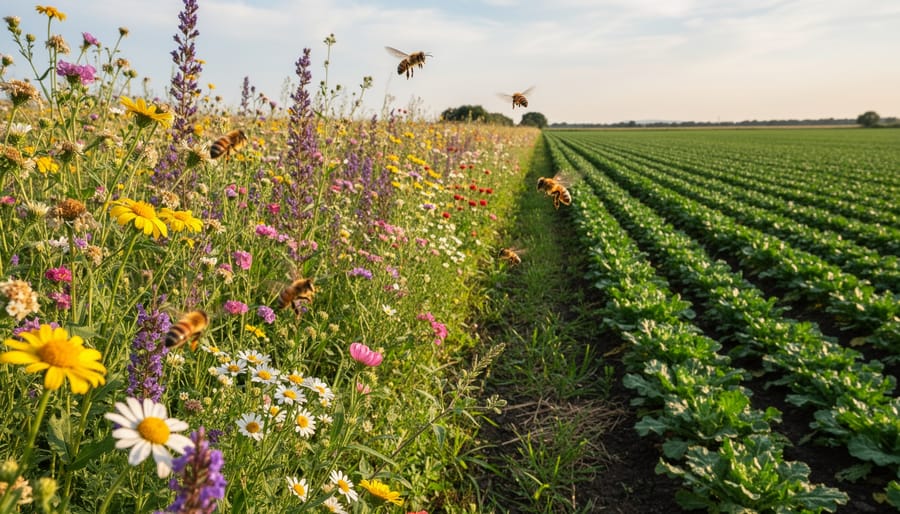
CERI Bee and Insect Biodiversity Initiatives in Action
The Community and Environment Research Institute addresses bee decline through multi-faceted programs that translate research into measurable conservation outcomes. CERI’s approach combines on-the-ground habitat work with policy advocacy and scientific investigation, creating integrated solutions rather than isolated interventions.
CERI’s habitat restoration projects focus on creating pollinator corridors that connect fragmented landscapes. Teams work with landowners, municipalities, and agricultural producers to establish native wildflower meadows, hedgerows, and managed grasslands that provide forage throughout the growing season. These projects prioritize plant diversity over monoculture plantings, ensuring bees access varied pollen and nectar sources from early spring through fall. In urban areas, CERI collaborates with city planners to retrofit parks, roadside verges, and corporate campuses with pollinator-friendly plantings, transforming unutilized green spaces into functional bee habitat. Monitoring data from restored sites show measurable increases in bee species richness and abundance within two growing seasons.
The institute’s research programs investigate stressors affecting bee health, including pesticide impacts, disease dynamics, and climate adaptation. Field studies track wild bee populations across different land-use gradients to identify which landscape features support resilient communities. CERI scientists collaborate with universities and government agencies on projects examining sublethal pesticide effects, nutrition quality in degraded habitats, and the role of managed honeybees in pathogen transmission to wild species. These findings inform evidence-based recommendations for conservation practice.
Policy advocacy forms a third pillar of CERI’s work. The institute provides technical expertise to policymakers considering pesticide regulations, advocating for restrictions on neonicotinoids and other compounds shown to harm bees at field-realistic concentrations. CERI staff testify at regulatory hearings, submit detailed comments on proposed chemical approvals, and partner with environmental organizations to build coalitions for protective policies.
Community engagement programs extend conservation capacity beyond CERI’s direct efforts. Workshops teach homeowners and land managers how to create pollinator habitat, recognize common bee species, and reduce pesticide use. Citizen science initiatives train volunteers to monitor bee populations, generating data that inform community sustainability planning while building public understanding of bee conservation needs. School programs introduce students to pollinator ecology through hands-on projects establishing campus gardens and observing bee behavior, cultivating the next generation of environmental advocates.
Common Questions About Bees as Keystone Species
Are all bee species considered keystone species?
Not all individual bee species qualify as keystone species, but bees as a functional group do. Some highly effective pollinators like bumblebees have disproportionate impacts on specific ecosystems, while honeybees and diverse native species collectively maintain broader ecosystem stability through their combined pollination services.
What’s the difference between bees and other pollinators in terms of ecosystem impact?
While butterflies, beetles, and flies contribute to pollination, bees pollinate a vastly wider range of plant species and do so more efficiently through specialized adaptations like pollen baskets and branched body hairs. Their deliberate foraging behavior and flower constancy make them irreplaceable for many wild and crop plants.
Can ecosystems actually survive without bees?
Ecosystems wouldn’t collapse overnight, but they would undergo severe degradation. Plant diversity would plummet as bee-dependent species fail to reproduce, followed by cascading losses of wildlife that depend on those plants for food and shelter. The resulting simplified ecosystems would be far less resilient to environmental stresses.
What can individuals do to support bee populations?
Plant native flowering species that bloom across seasons, eliminate pesticide use in gardens, provide nesting habitat like bare soil patches and hollow stems, and support organizations working on pollinator conservation. Community action multiplies individual efforts, creating pollinator corridors and protected habitats across neighborhoods.
Understanding these fundamentals helps translate awareness into meaningful conservation choices. Many people underestimate how accessible bee conservation is, you don’t need acreage or specialized knowledge to make a difference. A balcony container garden with the right plants supports urban bee populations. Advocacy for pesticide-free public parks protects entire communities of pollinators.
The questions people ask reveal common misconceptions worth addressing directly. Bees aren’t interchangeable with other insects, nor are they a monolithic group. The 20,000 bee species worldwide have varied life histories, from social colonies to solitary ground-nesters, but they share that keystone function. Their collective disappearance would reshape landscapes in ways we’re only beginning to document through research and environmental learning initiatives that connect habitat loss to tangible ecosystem changes. Recognizing bees’ irreplaceable role makes conservation efforts feel less abstract and more urgent.
The evidence is clear: bees are keystone species whose influence on ecosystems extends far beyond what their numbers suggest. Their pollination services sustain plant diversity, support complex food webs, and maintain the genetic resilience of plant communities. When bee populations decline, entire ecosystems begin to unravel, a reality already documented in regions experiencing severe pollinator losses.
We face an urgent conservation challenge. Habitat destruction, pesticide exposure, climate change, and disease continue to threaten bee populations worldwide. Yet this challenge is not insurmountable. The science shows us what works: habitat restoration, reduced pesticide use, diverse flowering resources, and policy changes that prioritize pollinator health.
CERI’s Bee and Insect Biodiversity Initiatives demonstrate how coordinated action can protect these keystone species. Through habitat restoration projects, policy advocacy, community engagement, and collaborative research, these programs address the root causes of bee decline while building public support for systemic change.
You have the power to strengthen this keystone. Plant native flowering species that provide season-long forage. Eliminate pesticide use in your gardens and advocate for restrictions on harmful chemicals in your community. Support organizations conducting bee research and habitat restoration. Contact local representatives to demand pollinator-friendly policies.
Every action matters because keystone species create disproportionate impact, and so can keystone actions by committed individuals. The bees that pollinate a third of our food crops and maintain ecosystem stability across the planet need our protection now. Their survival determines the health of ecosystems we all depend on. Choose to act, and you become part of the solution that ensures these irreplaceable species continue their essential work.